
The Holistic Philosopher
The Holistic Philosopher is a mini-article series that highlights hot-button topics related to health and wellness from a philosophical perspective. I recommend starting from the top and reading them in order. If not, scroll through to find a topic that sparks your interest!
(Only one article has been released so far, but more are coming soon)
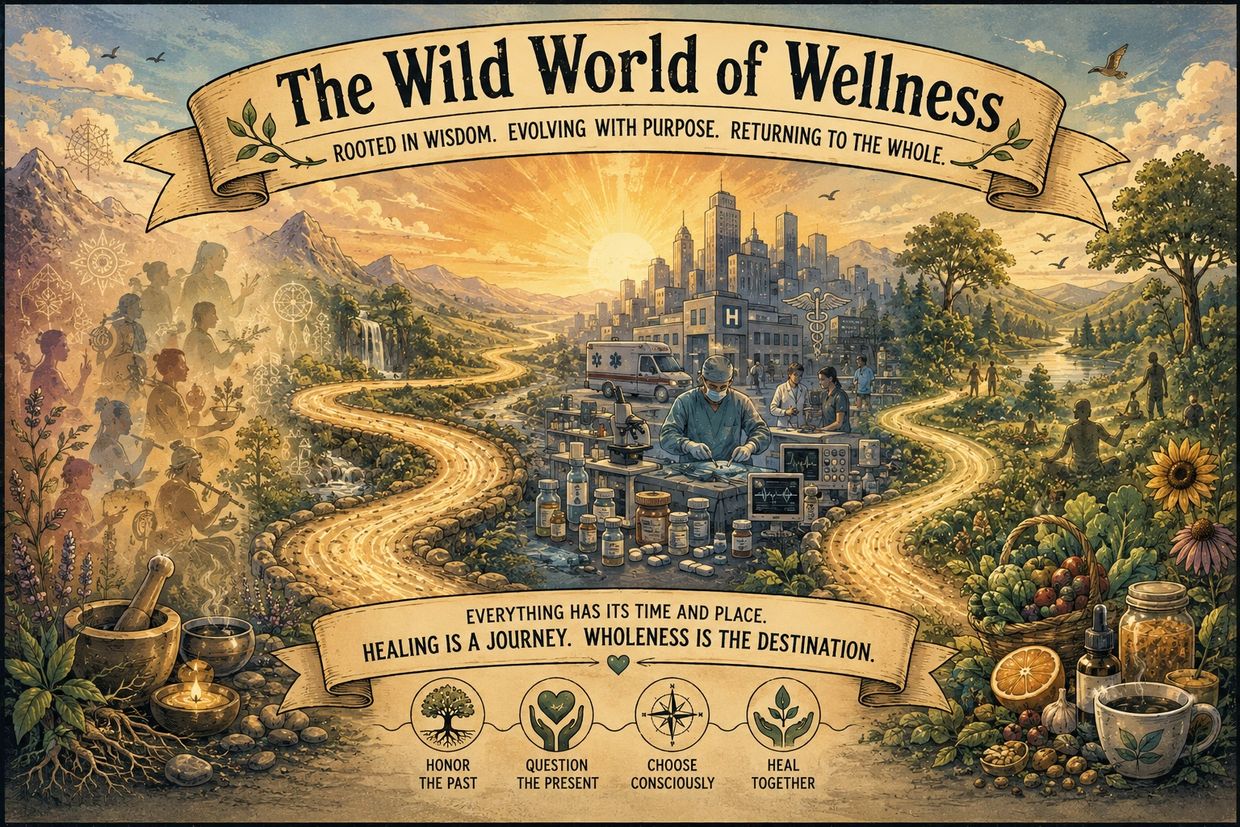
The Wild World of Wellness
Authored by James G Curtis
Published August 13, 2026
The transition from a philosophical outlook of holistic wellness to reductionist scientific methods has become a worldwide trend—one that deserves heightened attention. This phenomenon extends beyond professional spheres; it also reflects boldly in the general public. In many cases, it has led to the adoption of one-dimensional wellness practices that fall short of what could reasonably be considered a more complete approach to personal care.
For those unfamiliar, reductive health primarily focuses on alleviating discomfort by isolating and correcting an acute response in the mind or body. It emphasizes treating the symptoms or consequences associated with an illness, disease, or injury. For instance, a cut is treated with an adhesive bandage or stitches. If we experience a headache, many often take an over-the-counter medicine. Body soreness is most often addressed with muscle relaxants, topical supplements, or massage. When facing a sad or traumatic experience, people often see a psychologist or use psychiatric medications.
While reductive health primarily concentrates on isolated causes and effects, expansive approaches to healing seek to identify multilayered patterns and formulate multidimensional strategies that collectively address all elements of our wellness. For example, eating healthy food, staying properly hydrated, engaging in timely movement, or practicing calming breathwork can support many aspects of our mind and body in one swift dose.
Holistic ideology holds that treating the different components of our health and happiness as isolated entities is far less effective than addressing them together. This is because being chronically unwell physically can affect our ability to experience higher emotions such as joy, pleasure, and peace. If long-term fear, worry, or sadness persist, they can hinder an individual’s ability to meet their physical needs, cultivate social connections, advance in their career, and maintain mental stability. We don’t need years of study to grasp these concepts; we can observe these common realities by reflecting on ourselves or on others who are struggling with their overall health.
It is equally important not to confuse expansive health with modern holistic health from a philosophical or professional standpoint. Authentic holistic health is the unifying umbrella under which all forms of wellness find shelter, not any single reductive, expansive, historical, medical, traditional, or alternative means of healing. It brings together the many layers of our physical, mental, emotional, social, professional, and spiritual wellness while teaching us how to use them to sustain and enhance one another.
Holistic Philosophy’s primary concern is to distill all forms of wellness knowledge into accessible narratives through reasoned discourse. It focuses on teaching the overarching concepts that provide the foundation and framework for many of our reductive and expansive health approaches and methodologies. Its lessons are conveyed in everyday language with minimal technical jargon, making complex explanations of healing understandable to anyone interested. While health science excels at the ground level, holistic philosophy serves as the eye in the sky, guiding compartmentalized wellness toward comprehensive cooperation.
Other aspects of philosophy help us address social, cultural, and political issues that limit our capacity to care for ourselves ethically and, when necessary, challenge the global direction of our wellness sphere. Holistic-minded philosophy may not provide the type of healers and teachers most modern people recognize in the professional sense. Still, the essence of what we are describing has been instrumental in humanity's wellness evolution, and this vast community once provided world-renowned leaders to us:
Dhanvantari (of Ancient India) is said to be the Physician of the Gods. He is known as the Hindu father of Ayurveda, which is believed to be one of the oldest systems of health, healing, and happiness known to modern humans. It provides a rich history of the philosophy, science, spirituality, and art of healing and living. Regardless of whether one subscribes to its origin or creation history, it is still taught and practiced in many places around the world today due to its multilayered inclusivity and tradition.
Empedocles (494-434 BCE) was a Greek philosopher who taught that healing requires restoring the natural elements of ourselves or our world to a balanced state of order. He was known for using his knowledge to cure plagues and diseases. He often did so through basic lifestyle measures, such as cleaning up a community’s water supply.
Agnodice (4th century BCE) was one of the earliest women known to practice medicine professionally under Greek law, which didn’t allow females to do so in her time. However, she operated on the premise that girls and women should receive health care from other women in intimate situations, including those during pregnancy and birth.
Originally, she cut off her hair and disguised herself as a man to practice. Eventually, she revealed herself, even though she could have been sentenced to death for this defiance. Following this act of moral bravery, she successfully argued her case in court (with the support of many of her female patients), and the Athenian senate legally permitted women to practice medicine.
Hippocrates (460-370 BCE) was a Greek philosopher who is known as the Father of Western Medicine. He was a pioneer in distinguishing genuine healing methods from dubious practices and authored numerous medical texts. He also founded schools dedicated to the systematic study of disease and treatment. The Hippocratic Oath continues to be followed by many professional healers more than two thousand years later.
Sun Simao (581-682 CE) is known as the King of Chinese Medicine, integrating Daoist alchemy and philosophy with his medical practice. He was also held in high regard for pioneering medical ethics, teaching that a great physician must provide the same quality of care to all patients, regardless of factors such as status, gender, age, or wealth.
Ibn Sina, known as Avicenna in Western philosophy (980-1037 CE), was a renowned Persian polymath and philosopher who, over a millennium ago, taught that the reasoning mind must help heal the body and be used to understand the world around us. He also authored the famous book The Canon of Medicine, which served as a standard teaching guide throughout the Islamic world and Europe for hundreds of years. His philosophies and medical texts are still cherished by many today.
Saint Hildegard von Bingen (1098-1179 CE) was a German Benedictine abbess, mystic, writer, composer, and medical practitioner in the Catholic Church. She authored medical treatises, often detailing the healing properties of hundreds of plants for specific diseases. She did so while systematically blending Christian philosophy with experiences in infirmaries and dietary remedies. Some of her writings and works continue to be applauded, and she was honored with the title of Doctor of the Church in 2012.
Paracelsus (1493-1541 CE) was a Swiss doctor and philosopher, known as the Father of Toxicology. He revolutionized healing by applying chemistry and his metallurgical knowledge to his medical practice. His observations and high empirical standards of truth helped pave the way for modern pharmacology, while also advancing psychiatric treatment and psychological healing. His instruction that it is the dose that makes the poison (or the medicine) is still followed in many avenues of wellness today.
It should be noted that some of these individuals may not have identified themselves as academic philosophers. However, it is indisputable that the philosophical core of their cognition was employed consistently. Therefore, it remains an enduring responsibility of the reasoning mind to integrate the insights of science, the hindsight of history, the structure of politics, the art of aesthetics, the shining points of scripture, the ingenuity of entrepreneurs, and the tradition of generational knowledge, all under the overarching aim of health and happiness.
Throughout history, thousands of people and cultures from all over the world have sought to articulate the foundations of wellness. Many Indigenous and Aboriginal cultures—renowned for their healing wisdom—played a significant role in this process. Their teachings often included herbal, elemental, and cosmic epistemologies, as well as an incredible understanding of the natural lands, waters, and life that surrounds us. Many promoted a strong sense of community in their guidance, demonstrating not only how to promote wellness for our minds and bodies, but also how to foster health among one another and in our environments.
Philosophical foundations are designed to empower us to advance our personal health and happiness by our own hands while allowing this purpose to infuse every aspect of our lives with meaning and fulfillment. Many focus not on holistic healing but on holistic living. This basic form of personal, community, and global care meets our most fundamental needs, ensuring affordable and accessible vitality and joy for the many rather than the few.
Above all, philosophy provides us with some of the most amazing pearls of wisdom, which many healthy cultures and communities regard as the highest forms of human knowledge. Its guidance is timeless, universal, borderless, and eternal, consistently demonstrating how it can inspire and sustain not only individuals but entire nations.
It is no secret that few people view holistic living or philosophy as a primary “cure” for disease or depression over medical or clinical intervention. However, many avenues of healing knowledge reveal that many collections of behaviors, thoughts, feelings, and beliefs deter health issues from happening in the first place. Isn't that what part of a cure truly is—preventing illness or melancholy rather than just treating it after the fact? Living is what we must do every day, so we are wise to do it to the best of our abilities. Healing and medical correction, on the other hand, are often based on the reality of how well we are living.
Often, the greatest wellness advocates didn’t overcomplicate the matter of living a healthy and happy life. They resembled the quiet personality of a local general store or small market. These humble establishments were always known for supplying nearly all the goods a family needed each week, including a small selection of toys or treats for our enjoyment. Similarly, many holistic philosophers offered a one-stop shop of wellness knowledge, and perhaps a little extra advice for humor and good spirits.
Unfortunately, many believe that an obsessive amount of information, remedies, technology, health professionals, or procedures leads to greater well-being. Yet, with all this surplus, why aren’t we seeing the same radical inflation of our health and happiness? Instead, many are having to work twice as hard to survive, with only a minimal increase in the quality and quantity of their lives. This doesn’t mean our intelligence is lacking; rather, it prompts us to reevaluate our purpose and ensure we are using our knowledge wisely.
Again, these sentiments don’t imply we cease exploring wellness via reductive measures and the microscopic world. Our progress in scientific intelligence and compartmentalized health helps relieve and alleviate many forms of pain and suffering, and it has been lifesaving when unexpected harm arises from the dangers and difficulties of human life. However, it is important to recognize that these health interventions aren’t meant to keep the majority of our well-being afloat, as many are attempting to do so with them.
Roughly half a millennium ago, Sir Thomas More wrote, "One of the greatest problems of our time is that many are schooled but few are educated." Thousands of healers and educators have echoed this sentiment since then, urging us to reflect on our knowledge and purpose rather than mindlessly consuming information and applying it without foresight or direction.
So yes, it has become evident that 'The Wild World of Wellness' is facing challenges in our modern era. Perhaps holistic philosophy can help tame its undisciplined nature.
James G Curtis is a philosopher, writer, and explorer of human purpose. He is the author of the Another Pathway wellness series and the recently published book A Philosophy of Health and Happiness, both of which are now available online and at jamesgcurtis.com.
The information provided in this article is for educational and philosophical purposes and should not be taken as professional medical advice.